Let's Share it

Contact Us

Have Any Questions? +61488383308
Contact Us
Send Us mail

Your Idea, Our Expertise — Contact ESD Today.


    AS1657 Handrail & Guardrail Compliance Guide

    For builders and fabricators working on platforms, walkways, stairways, and fixed ladders, one of the most important standards to meet is AS1657:2018. This standard sets out how handrails, guardrails, platforms, and access systems must be designed, built, and installed to keep people safe and projects compliant with the NCC (National Construction Code).

    Getting AS1657 wrong can mean failed inspections, costly rework, and project delays. At ESD, we simplify compliance by providing CAD drawings, fabrication details, and fast certification — so your project is safe, practical, and approved on the first submission.

    To help you navigate the details, this guide is structured into sections covering all aspects of AS1657 handrail and guardrail compliance. Use the quick links below to jump directly to the information you need.


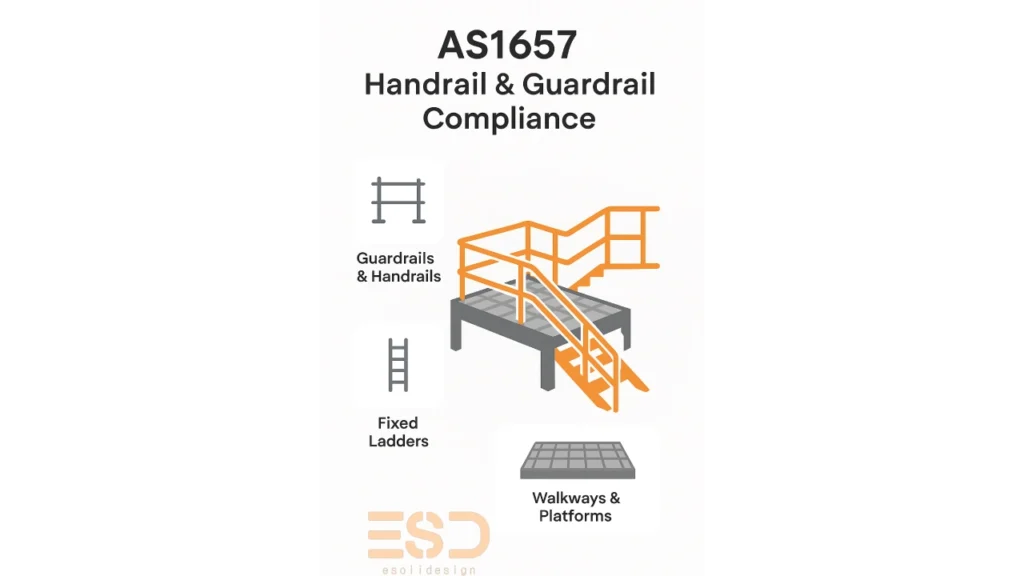
    AS1657 Handrail & Guardrail Compliance

    What is AS1657:2018?

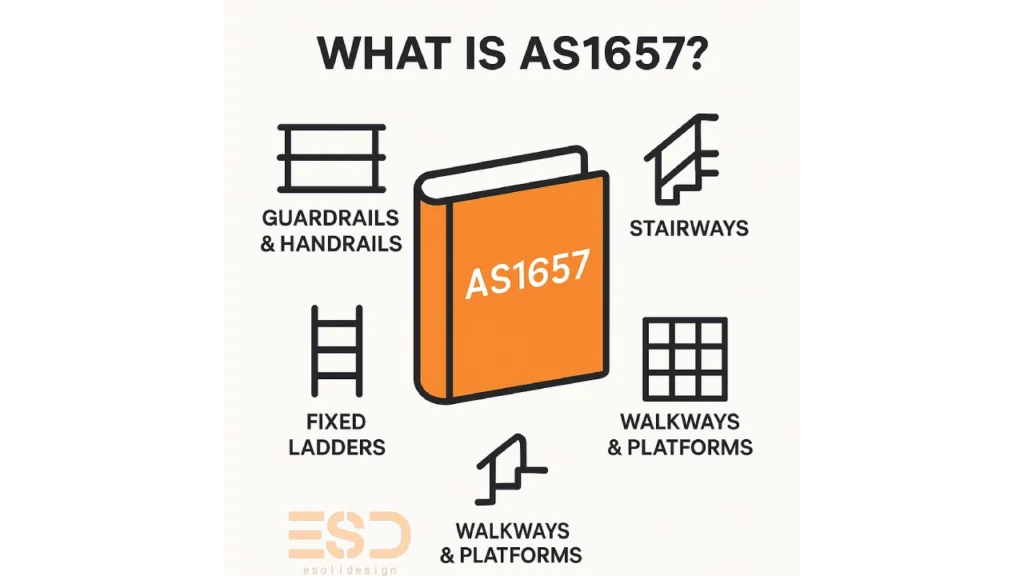
    AS1657:2018 is the Australian Standard that sets out the design, construction, and installation requirements for:

    • Guardrails & handrails on platforms and walkways
    • Fixed ladders for safe access
    • Stairways in industrial or commercial settings
    • Platforms & walkways for factories, plants, and work areas

    The purpose of AS1657:2018 is to ensure that any area where people access, work, or move is protected against falls and built to a safe, consistent standard.

    In practice, this means making sure:

    • Handrails and guardrails are built to the right height and strength
    • Walkways and platforms are safe to walk on and properly supported
    • Ladders and stairs meet safe slope, spacing, and access requirements

    At ESD, we take these requirements and turn them into clear, buildable documentation that saves you time and gets you certified faster.


    What is AS1657?

    Guardrail & Handrail Dimensions (AS1657:2018  Requirements)

    Handrail Requirements

    AS1657 sets out clear requirements for the height, shape, and clearances of handrails:

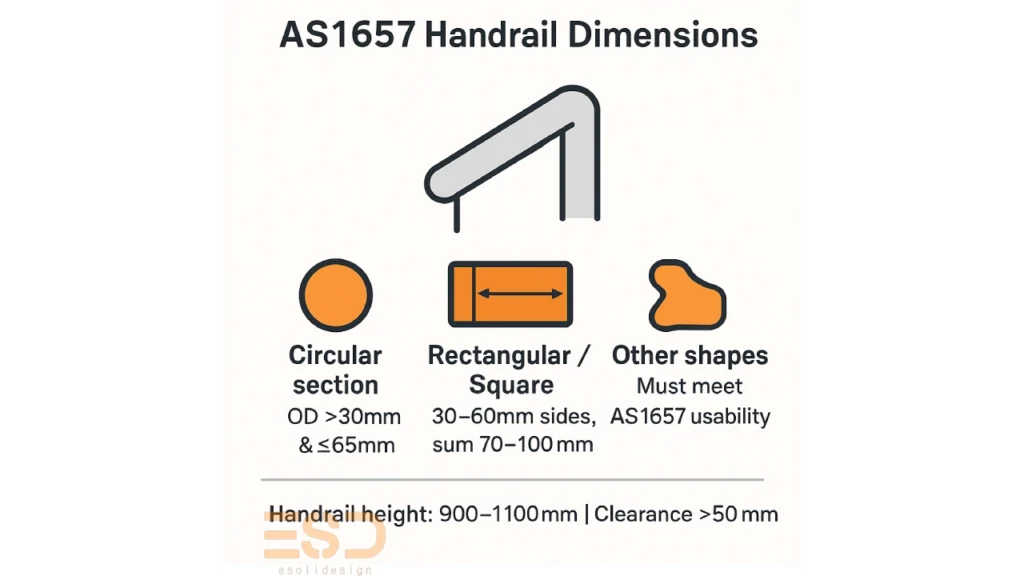
    • Height: Handrails must be installed between 900 mm and 1100 mm, measured vertically from the floor, walkway surface, or stair tread nosing.
      Handrail should not have any sharp edges or splinters.
    • Handrail Dimensions:
    ShapeDimension Requirements
    Circular30 mm < Handrail Outside Diameter (OD) < 65mm
    Rectangular / Square- Each side: 30 mm – 60 mm
    - Sum of height + width: 70 mm – 100 mm
    Other ShapesCheck Clause 5.6.4.3 (AS1657:2018)
    • Hand Clearance: A minimum 50 mm clearance is required between the handrail and any adjacent structure, ensuring users can grip it safely without obstruction.
    • Longitudinal Movement Clearance: Min 240 degree area to be clear for hand longitudinal Movement

    At ESD, we take these technical requirements and translate them into fabrication-ready CAD drawings and certification documents, so your installers know exactly what to build — and inspectors can approve it without delays.

    AS1657 Handrail Requirements

    Infill Requirements (AS1657:2018)

    Where infill is required to close gaps in a guardrailing system, AS1657:2018 allows a range of materials — such as pipe, bar, solid or perforated plate, expanded mesh, or weldmesh.

    Key compliance points:

    • The area of any opening must not exceed 0.2 m².
    • Infill must be free from sharp edges or projections.
    • If metal mesh is used, a rigid top rail must be installed to provide strength and stability.

    At ESD, we design and document infill systems to meet these requirements, ensuring your guardrailing is both safe and certifiable.

    AS1657 Infill Requirements

    Toeboard Requirements (AS1657:2018)

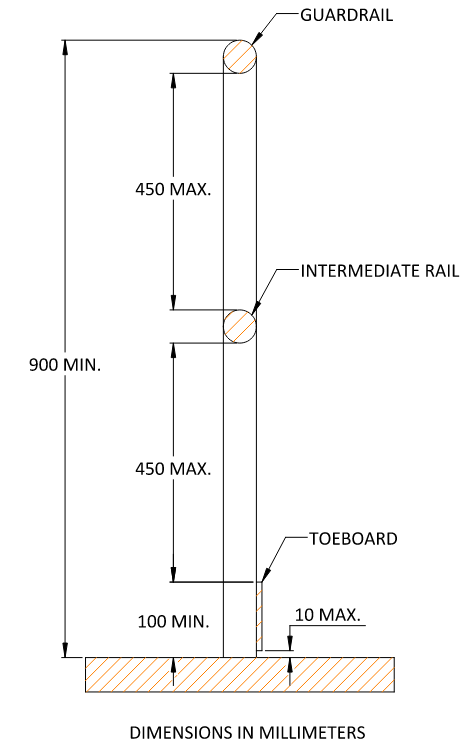
    AS1657:2018 specifies that a toeboard (also called a kickplate) must be fitted to prevent tools or objects from falling off platforms and walkways, it’s dimensional requirements are:

    • The toeboard height above must be at least 100 mm above the floor or walkway surface.
    • The gap between the bottom edge of the toeboard and the floor or walkway surface must be no greater than 10 mm.
    RequirementMeasurement (AS1657:2018)
    Minimum Toeboard Height≥ 100 mm (from floor/walkway to top of board)
    Maximum Bottom Gap≤ 10 mm (from floor/walkway to bottom edge)

    Lorem ipsum dolor sit amet, consectetur adipiscing elit. Ut elit tellus, luctus nec ullamcorper mattis, pulvinar dapibus leo.

    Loading & Deflection Criteria (AS1657:2018)

    AS1657:2018 sets out strict performance requirements for guardrails, toeboards, and infill. Builders and fabricators must design each component to withstand specific loads and limit deflection, ensuring systems remain safe and compliant under use.

    Guardrails & Handrails — Imposed Loads

    Guardrails and intermediate rails must withstand the following imposed actions:

    • Point Load: Apply a 600 N force outwards or downwards at any location on the top rail, intermediate rail, or post.
    • Uniformly Distributed Load: Apply a 350 N per metre force acting outwards or downwards on the top rail or intermediate rail.
    • Wind Load: For external installations, apply wind loading as per AS/NZS 1170.2.

    Designers must treat these load cases separately. Do not add them together — always design for the worst effect.

    Guardrail & Handrail — Deflection Criteria

    • No part of the system may deflect more than 100 mm elastically under the 600 N point load or 350 N/m distributed load.
    • This limit includes deflection in the structural fixings.

    Toe Board — Imposed Loads

    Toe boards on platforms and walkways must handle a 100 N horizontal force applied at the most critical point of the board. This ensures the toe board can resist accidental impacts or objects pressing against it.

    Toe Board — Deflection Criteria

    • The horizontal gap between the inside face of the toe board and the edge of the walkway or platform must not exceed 10 mm.
    • Under load, the toe board must not deflect by more than 30 mm elastically.

    Infill — Imposed Loads

    Infill panels that form part of a guardrail or handrail system must resist the greater of these loads:

    • A 500 N horizontal point load, or,
    • A 1 kPa uniformly distributed horizontal pressure applied over the infill panel.
    • For external sites, you must also consider wind loading in line with AS/NZS 1170.2.

    Infill — Deflection Criteria

    • Infill must not deflect to the point of creating unsafe gaps.
    • The system should remain stable and resist movement under the applied load cases.
    ComponentImposed LoadsDeflection Criteria
    Guardrails & Handrails- 600 N point load (outward or downward)
    - 350 N/m distributed load (outward or downward)
    - Wind load per AS1170.2
    Max elastic deflection: ≤ 100 mm (includes fixings)
    Toeboard- 100 N horizontal load- Max gap to platform edge: ≤ 10 mm
    - Max elastic deflection: ≤ 30 mm
    Infill- 500 N horizontal point load OR
    - 1 kPa uniformly distributed horizontal pressure
    - Wind load per AS1170.2
    No unsafe deflection permitted

    These criteria ensure that handrails, guardrails, toe boards, and infill systems remain stable, safe, and compliant under load. By limiting deflection and enforcing clear load requirements, AS1657 helps prevent failures during normal use, inspections, and external conditions such as wind. At ESD, we test and document these requirements through CAD design, structural checks, and certification, so builders and fabricators can install with confidence.

    Recommended Component Dimensions & Materials (Appendix A, AS1657:2018)

    Appendix A of AS1657:2018 gives recommended minimum dimensions and materials for typical edge protection components. These recommendations apply when components have not been specifically designed and tested under Clause 6.1. While this section is informative (not mandatory), it provides useful guidance to ensure safety and consistency.

    Steel Components (Table A1)

    For typical steel edge protection systems, the following minimum sizes are recommended (based on 1000 mm post height and 2400 mm spacing):

    ComponentSteel Section (mm)Steel Pipe (OD x wall thickness mm)
    Stanchions (Posts)65 × 65 × 5 angle48.3 × 3.2 wt
    Top rail50 × 50 × 5 angle33.7 × 3.2 wt
    Intermediate rails40 × 40 × 5 angle26.9 × 3.2 wt
    Toeboards100 × 6 flat-

    Aluminium Components (Table A2)

    For aluminium guardrail and handrail systems (mechanical fixings only, not for welded fabrications), the following sections and alloys are recommended (based on 1000 mm post height and 2000 mm spacing):

    ComponentAluminium Shape & Dimension (mm)Alloy / Temper Range
    Stanchions (Posts)65 × 65 × 2.5 square hollow
    60 × 5 round tube
    60 × 50 × 3 rectangular hollow
    Class 1 or Class 2 alloys
    Stanchions (Posts)50 × 50 × 2 square hollow
    50 × 3 round tube
    Class 2 alloys
    Top rail50 × 50 × 1.6 square hollow
    50 × 3 round tube
    Class 1 or Class 2 alloys
    Intermediate rail38 × 2 round tubeClass 1 or Class 2 alloys
    Toeboard [midspan fix]100 × 6 flat barClass 1 or Class 2 alloys
    ClassAlloys (examples)
    16060-T5, 6063-T5, 6063-T6
    26061-T6, 6005A-T5, 6005A-T61, 6351-T5, 6351-T6, 6082-T5, 6082-T6

    Verification and Testing (AS1657:2018)

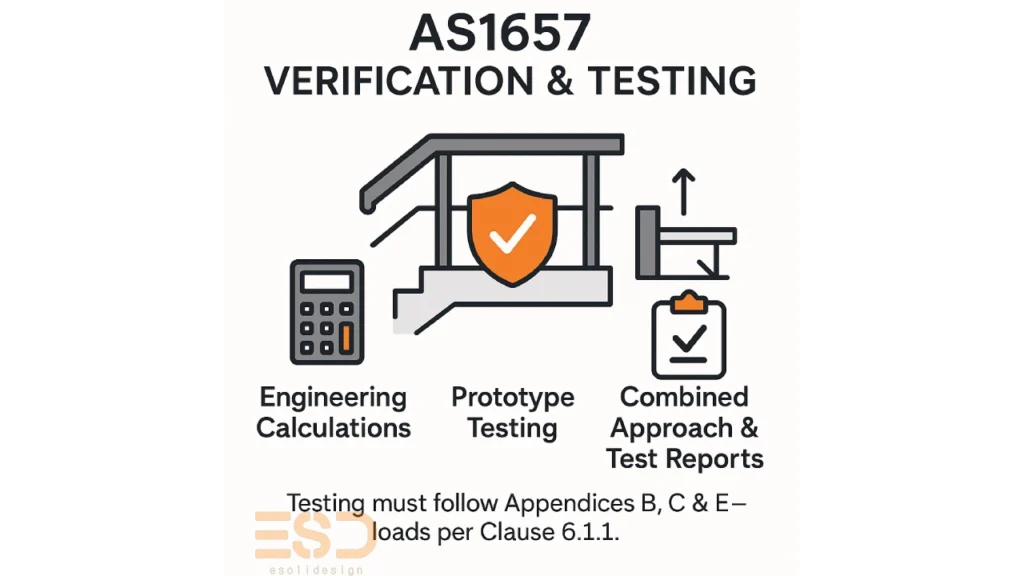
    To confirm compliance with AS1657, every guardrail system must go through verification and testing. The standard allows three pathways:

    1. Engineering calculations — Detailed structural calculations of the proposed design.
    2. Prototype testing — Physical testing of a guardrail prototype.
    3. Combined approach — For proprietary systems (those sold to third parties), both engineering calculations and prototype testing are required. Testing must follow the procedures in Appendices B and C.

    When testing is used, the connections between the guardrail posts and the supporting structure must withstand the test forces set out in Appendix B. These test forces reflect the imposed loads described in Clause 6.1.1.

    All testing must produce a formal test report as specified in Appendix E.

    Note 1: Guardrailing systems built to the recommended materials and dimensions in Appendix A are already assessed as conforming to AS1657 requirements.
    Note 2: The test forces in Appendix B are based directly on the imposed loads required in Clause 6.1.1.

    AS1657 verification and testing

    At ESD, we support both engineering verification and physical testing. Our team provides calculations, CAD documentation, and certification, and can also assist with test planning and reporting so your system passes without delays.

    Construction Requirements (AS1657:2018)

    Post and Rail Construction

    Where guardrailing is built with post and rail construction, the following requirements apply:

    (a) The system shall include a top rail that is:

    • (i) supported by posts at intervals sufficient to meet the required imposed actions; and
    • (ii) parallel to the floor or, where used on a sloping walkway, parallel to the slope of the walkway.

    (b) One or more intermediate rails shall be installed parallel to the top rail, spaced so that the maximum clear distance between rails, or between the lowest rail and the toe board (where fitted), does not exceed 450 mm.

    (c) If no toe board is provided, the clear distance between the lowest rail and the floor shall not exceed 560 mm.

    (d) Where removable sections of guardrailing are required, the maximum clear distance between guardrail elements shall be more than 25mm and less than 50mm.

    Welded Mesh Construction

    Where guardrailing is built with welded mesh, the following requirements apply:

    (a) The welded mesh shall be supported by posts at intervals sufficient to meet the required imposed actions.

    (b) The guardrailing shall include a reinforced top edge and must be capable of withstanding the imposed actions given in Guardrails & Handrails- Imposed Loads section. 

    Why Choose ESD for AS1657 Compliance Projects

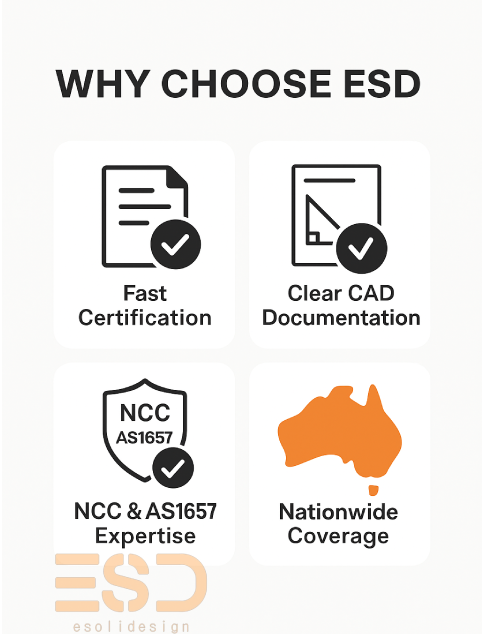
    When it comes to AS1657 guardrail and handrail compliance, builders and fabricators across Australia trust ESD. We combine technical expertise with practical engineering to make compliance simple, fast, and reliable.

    • Fast Certification – Get REG126, Form 15, and Form 12 certificates issued quickly, keeping your projects on schedule.
    • 📐 Clear CAD Documentation – Fabrication-ready CAD drawings and shop details that installers can follow with confidence.
    • NCC & Standards Knowledge – In-depth expertise with the NCC, AS1657, and related standards like AS1170 and AS1428.
    • 🌏 Nationwide Coverage – No matter where your project is, we provide support and certification across Australia.
    Why Choose ESD

    Ready to Get Your Handrails Certified?

    Don’t let compliance slow down your project. At ESD, we deliver fast certification, accurate CAD drawings, and full AS1657:2018 compliance — so you can build with confidence.

    Call us today or request a no-obligation quote — and get your handrail and balustrade project moving.


    Let's Share it
    top
    SEND US A MAIL

    Let’s Discuss Your Project

      Launch Your Project

      At ESoliDesign, we’re here to bring your vision to life. Whether you have a question, need a consultation, or want to discuss your next project, our team is ready to help.

      Fill out our contact form, and we’ll get back to you promptly. Let’s create something exceptional together!

      Contact:

      Melbourne, Australia