Deflection Acceptance Criteria
No part of the system shall deflect elastically more than 100mm under imposed loads.
AS1170.1: 2002
Section 3.6 in AS1170.1 outlines the load prerequisites for various barrier situations, as detailed in Table 3.3. Notably, this standard does not make distinctions between handrails and guardrails in this context.
Deflection Acceptance Criteria
This standard does not impose obligatory criteria for deflection. However, it’s worth noting that Appendix C in AS1170.0, Table C1, provides guidance. According to this table, the suggested deflection for handrails is calculated as Height/60 + Span/240.
AS1428.1:2021
In Section 9 of this standard, handrails are addressed. Like AS1170, there is no differentiation made between handrails and guardrails. Through a thorough examination of the document, it becomes apparent that the term “guard” is not employed within this context.
The physical requirements of this standard for handrails are:
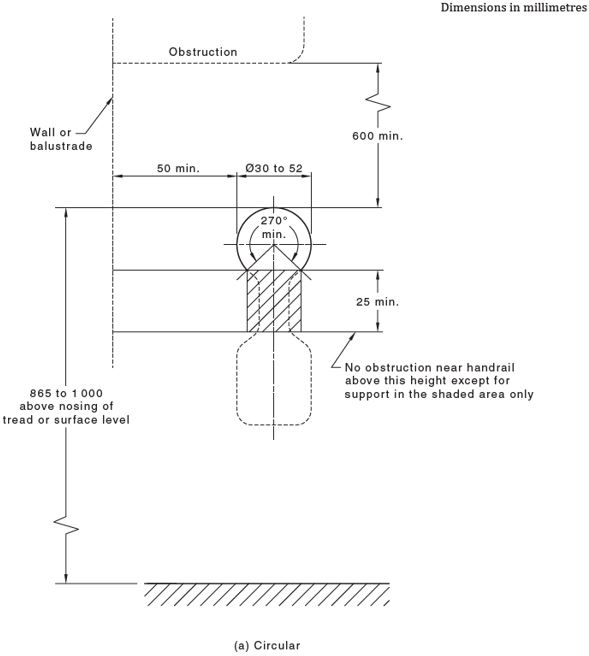
- Handrail shapes could be circular or elliptical with diameter between 30 to 52mm, with 270° clear area around the outer surface of the handrail,
- Distance from top of the handrail to the nosing of the stairway tread or finished floor plane of walkway shall be from 865 to 1000,
- Clearance between a handrail and surrounding surfaces shall be more than 50mm. Clearance above handrail shall not be less than 600mm, figure (3),
- There shall not be any obstruction on hand passage along the handrail,
There is no load nor deflection requirements on this standard; also, there is no differentiate between handrail and guardrail.