
Project Overview

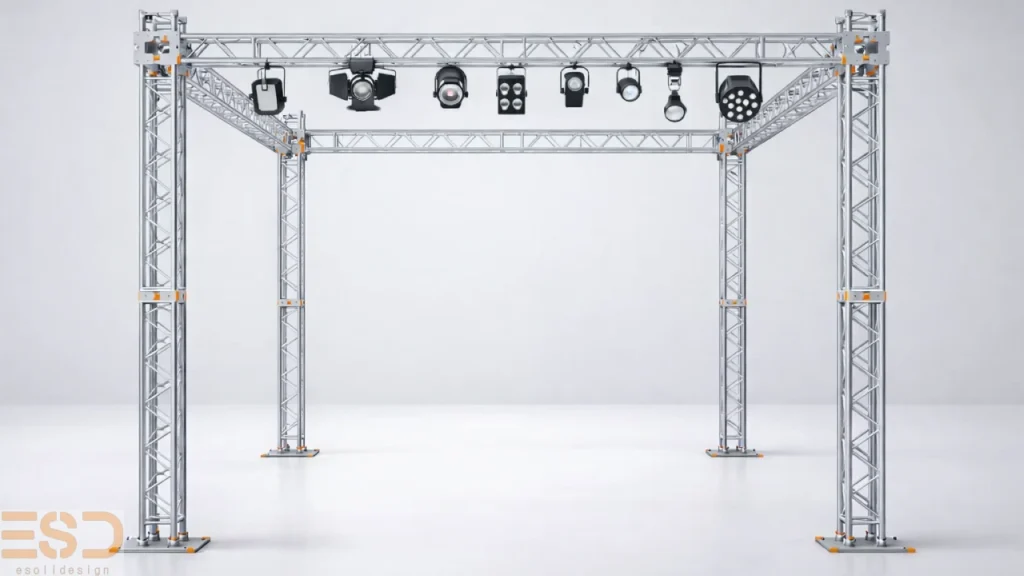
Installation Theatrical Engineering (ITE) engaged ESoliDesign (ESD) to provide a structurally robust and commercially viable theatre lighting box truss system suitable for professional entertainment and stage environments.

The client required an engineering-led solution that not only met strength and safety expectations, but also delivered superior stiffness performance, with deflection behaviour demonstrably better than comparable products currently available in the market.

From the outset, the brief emphasised:

  • Development of a modular box truss range covering short to long spans,
  • Controlled deflection performance under realistic theatrical loading scenarios,
  • Optimised connection assemblies that enhance stiffness without excessive weight or fabrication complexity.
  • Clear, manufacturer-ready load and deflection data derived from engineering analysis
  • A solution that balances structural performance, practicality, and cost efficiency

To address these requirements, the design approach deliberately targeted deflection limits lower than those typically observed in competing systems, as verified through static finite element analysis (FEA). This ensured that the resulting truss system not only met functional requirements, but also offered a measurable performance advantage in serviceability and perceived quality during installation and operation.

theater lighting truss design

Engineering Scope & Design Challenges

Designing a theater lighting truss is not just about ensuring it is strong enough — it is about ensuring it behaves well in service.

For this project, the governing design driver was deflection control, rather than ultimate strength. In theatrical environments, excessive sag or movement can affect light alignment, visual presentation, and user confidence, even when structural capacity is technically adequate.

The engineering scope therefore focused on developing a box truss system that remained visibly stiff under realistic lighting loads, particularly across longer spans. This required careful consideration of how individual members, chords, and connections work together as a complete structural system.

Key challenges addressed during the design phase included:

  • Managing mid-span deflection for both evenly distributed loads and central point loads,
  • Achieving consistent performance across a wide span range from 0.5 m to 12.0 m,
  • Optimising connection behaviour, recognising that joints play a major role in overall stiffness,
  • Balancing structural performance with manufacturing practicality and cost efficiency,
  • Ensuring the system could be supported by clear, defensible engineering data.

Rather than relying on rule-of-thumb sizing, the design approach prioritised measurable stiffness improvements, resulting in deflection outcomes lower than those typically observed in comparable systems. This ensured the final truss design not only met functional requirements, but also delivered a more stable and confidence-inspiring product in use.

Box Truss System Development

To support a wide range of theatrical applications, the project focused on developing a modular box truss system capable of performing consistently across both short and long spans, up to 12m.

Rather than designing a single truss length, ESD engineered a scalable family of box truss modules covering spans from 0.5 m through to 7.0 m. Each length was proportioned to maintain structural stiffness, practical manufacturability, and visual consistency when assembled into larger lighting structures.

This modular approach allows production teams to configure lighting frames efficiently while maintaining predictable structural behaviour across different layouts and span combinations. The geometry, member sizing, and connection interfaces were therefore developed as part of a cohesive system, not as isolated components.

Throughout the development process, particular attention was given to:

  • Maintaining consistent stiffness performance as span length increases
  • Ensuring repeatable geometry suitable for fabrication and assembly
  • Supporting interchangeable modular use within theater and live-event environments
  • Preparing the system for structural verification and load-table development

The resulting box truss range forms the engineering foundation for subsequent structural analysis, deflection verification, and practical testing described in the following sections.

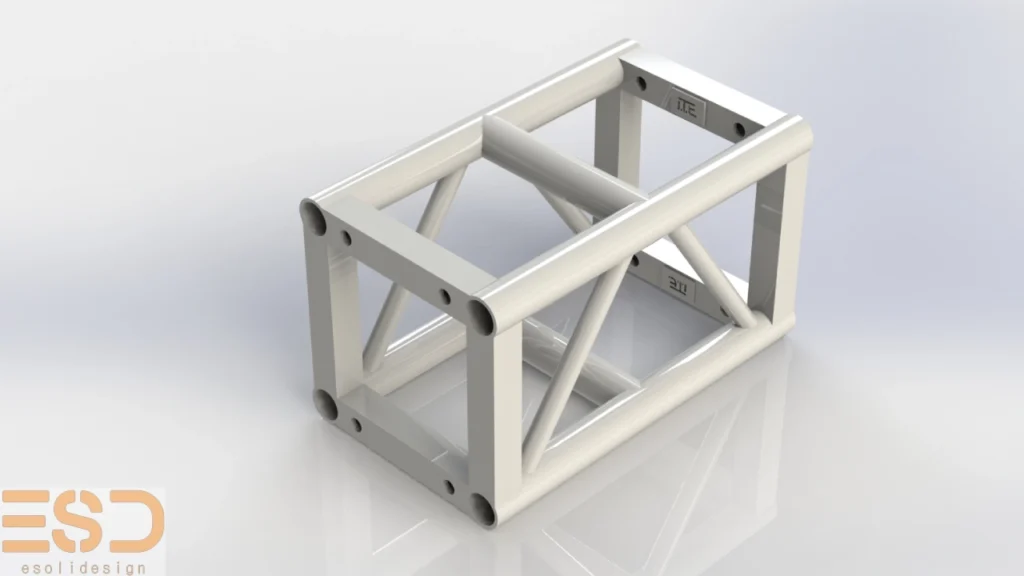
Modular aluminium theatre lighting box trusses – 0.5m,span configuration
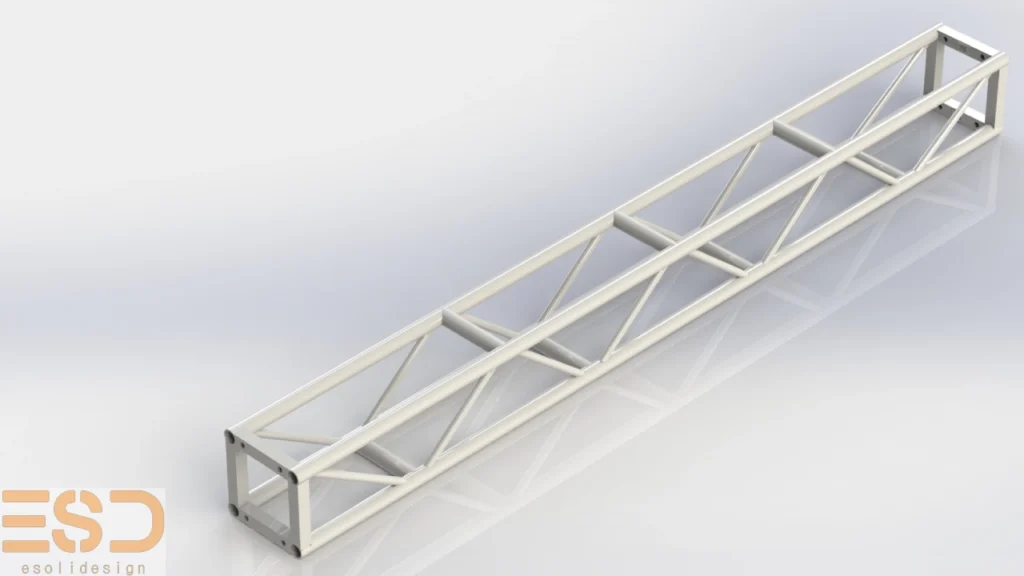
Modular aluminium theatre lighting box trusses – 3.0m span configuration
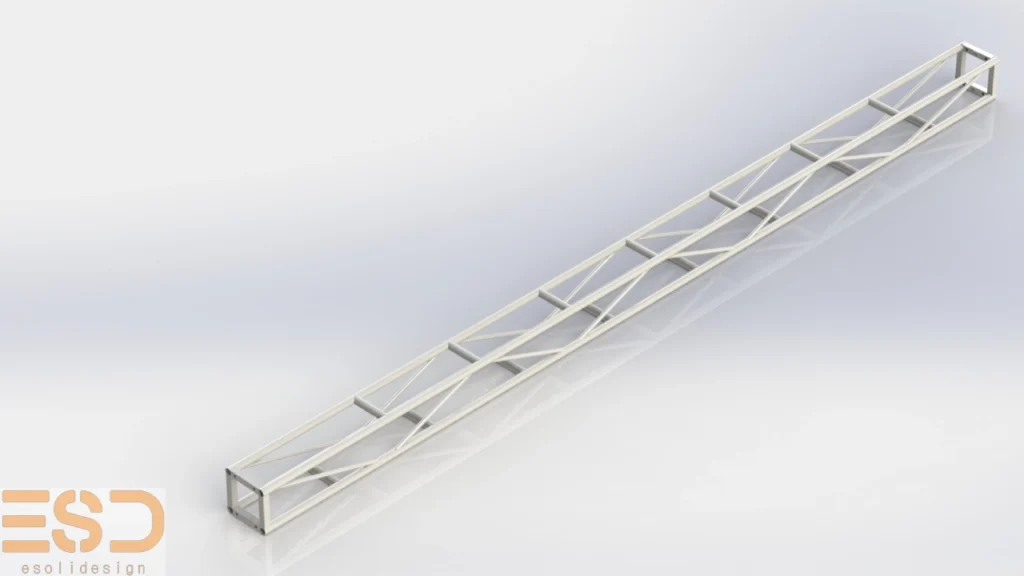
Modular aluminium theatre lighting box trusses – 6.0m span configuration

Connection Strategy & Deflection Optimisation

Connection Strategy & Deflection Optimisation

In truss systems, overall stiffness is not determined by member sizing alone.
Connection behaviour plays a critical role in controlling deflection, particularly across longer spans.

For this project, the connection assemblies were not treated as secondary hardware, but as structural elements contributing directly to system performance. Multiple joining configurations were assessed to understand how different interface geometries influence rotational restraint, load transfer efficiency, and mid-span displacement.

The objective was simple:
Develop a connection solution that improves stiffness performance without introducing unnecessary fabrication complexity or excessive weight.

Through comparative analysis, the selected connection configuration demonstrated:

  • Improved rotational restraint at joints,
  • Reduced cumulative mid-span deflection,
  • More consistent behaviour across modular span combinations,
  • Practical manufacturability using realistic fabrication methods

The resulting system achieved deflection outcomes lower than those typically observed in comparable box truss systems, while maintaining structural efficiency and ease of assembly.

Rather than increasing material thickness or adding unnecessary mass, stiffness gains were achieved through optimised connection geometry and load path control. This approach ensures the truss performs reliably in service, delivering improved visual stability under lighting loads.

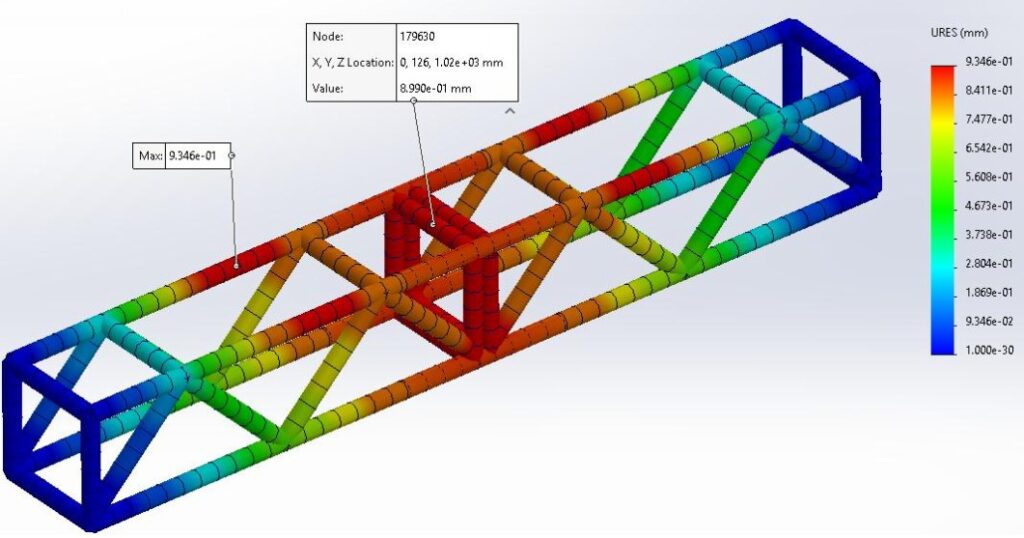
Finite element deflection analysis of Connection Type A in modular theatre lighting box truss system under static loading.
Connection Type A — Initial Concept
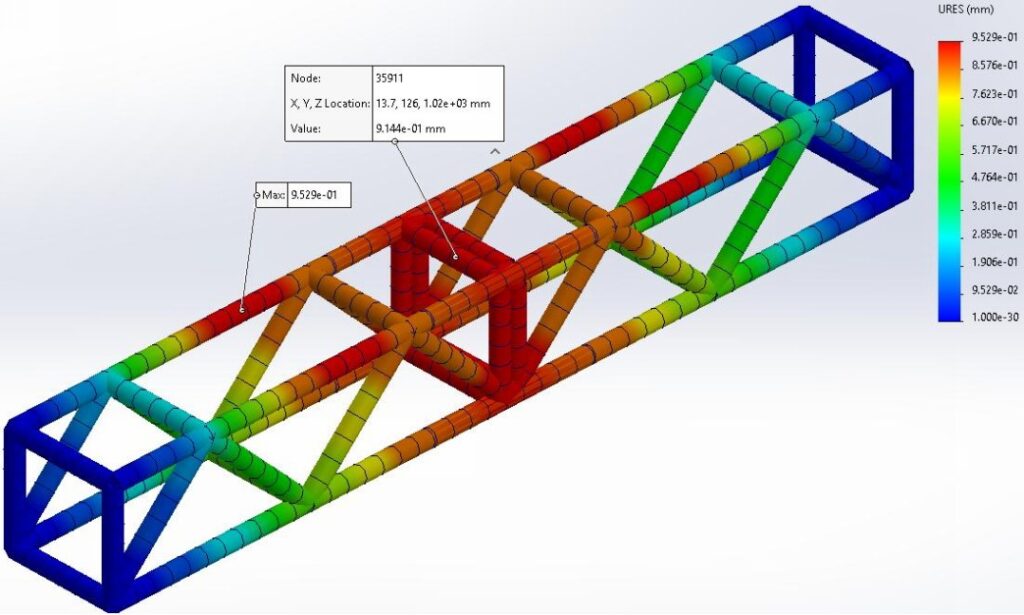
Static FEA contour plot of Connection Type B showing deflection response in theatre lighting box truss joint.
Connection Type B — Revised Geometry
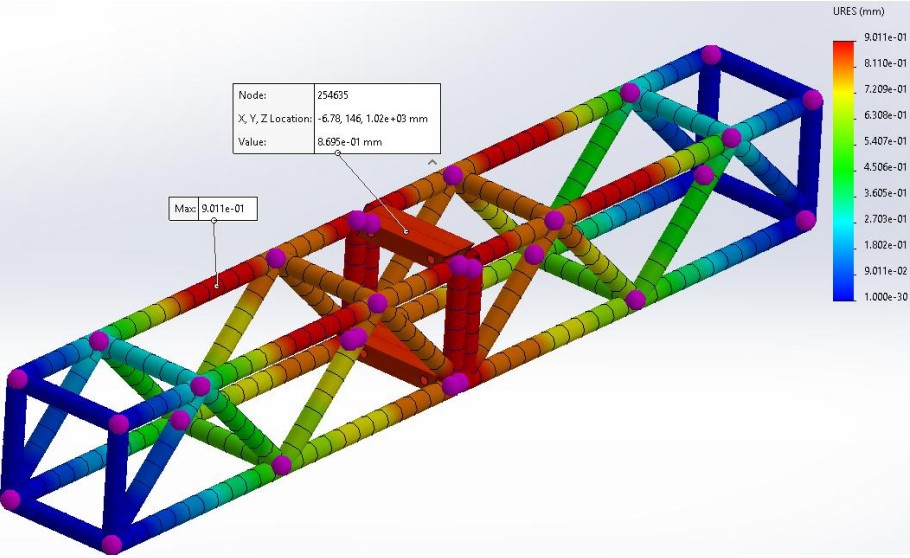
Optimised box truss connection FEA showing reduced deflection and improved stiffness performance under static load.
Connection Type C — Final Optimised Configuration

Comparative connection analysis ensured stiffness improvements were achieved through geometry optimisation rather than unnecessary material increase.

Structural Analysis & Performance Verification

Structural Analysis & Performance Verification

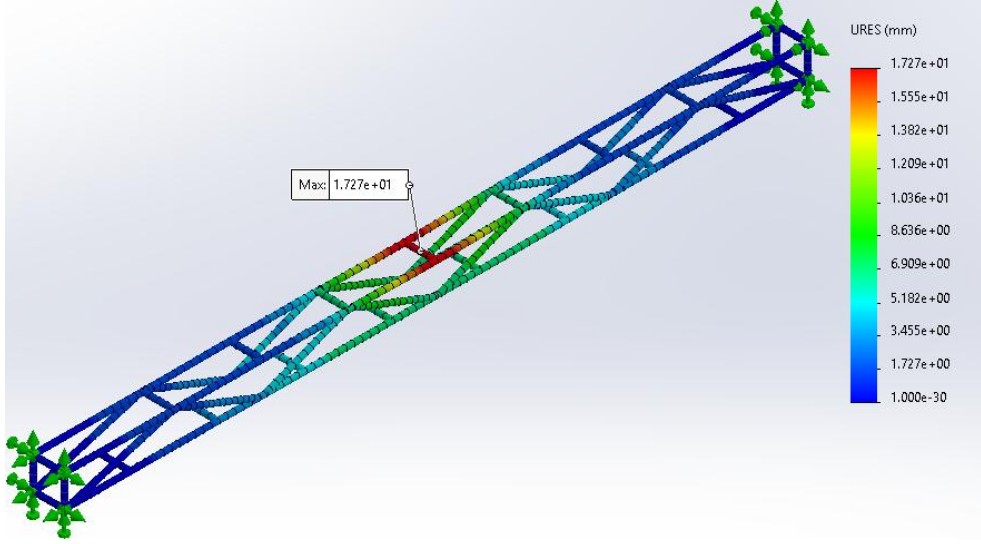
Following connection optimisation, the complete box truss assemblies were subjected to static finite element analysis (FEA) to verify global structural behaviour across the full span range.

The objective of this stage was twofold:

  1. Confirm structural capacity under representative lighting loads,
  2. Validate serviceability performance, with particular focus on deflection control.

Each span length — from 0.5 m through to 12.0 m — was analysed under realistic loading scenarios to ensure predictable behaviour across the modular system.

Two primary load cases were evaluated:

  • Uniformly distributed load, simulating evenly spaced lighting fixtures,
  • Central concentrated load, representing localised or worst-case fixture placement.

The analysis confirmed that the system maintained controlled mid-span deflection within targeted performance limits. The optimised connection geometry and coordinated member proportions contributed directly to improved stiffness behaviour without requiring excessive material increase.

Rather than designing purely for strength, the system was engineered to perform reliably in service, ensuring stable lighting alignment and confidence during installation and operation.

The verified deflection results formed the technical basis for the development of performance tables and documentation presented in the following section.

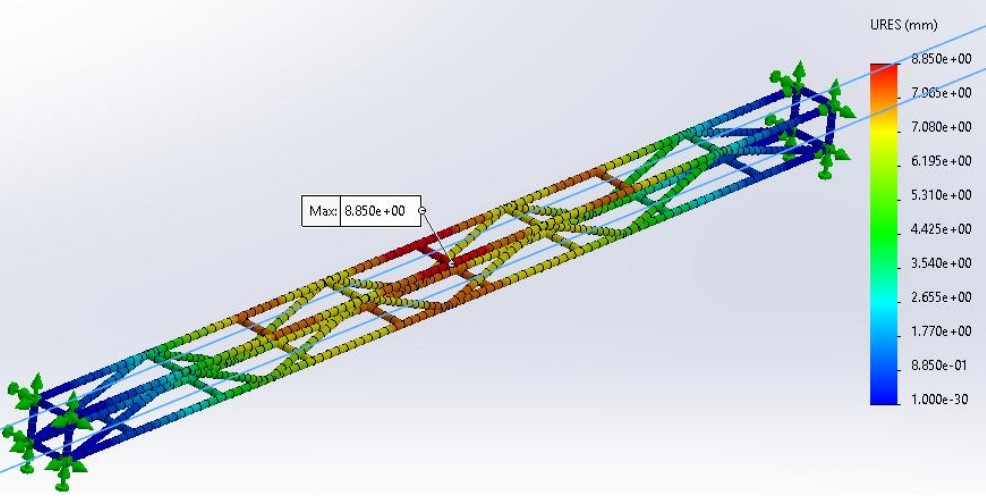
Finite element deflection contour of modular theatre lighting box truss under uniformly distributed lighting load.
Uniformly distributed load case illustrating controlled mid-span deflection behaviour across the box truss span.
Static FEA deflection analysis of theatre lighting box truss under central concentrated load condition.
Central concentrated load case representing worst-case fixture placement and corresponding displacement response.

Load Tables & Performance Outputs

Load Tables & Performance Outputs

To translate the analysis results into practical guidance for fabrication and installation, comprehensive load and deflection tables were developed for the full box truss range.

These tables provide clear, span-specific performance data under defined loading conditions, allowing the system to be applied confidently in real-world theatre and live-event environments.

For each span length, the documentation includes:

  • Maximum allowable uniformly distributed load,
  • Deflection values under distributed load,
  • Deflection values under central concentrated load,
  • Performance limits aligned with serviceability objectives.

Rather than presenting raw analysis outputs, the results were structured into clear, manufacturer-ready reference tables, supporting straightforward interpretation by production teams, designers, and installers.

This approach ensures that structural performance is not only verified, but also accessible and actionable.

The load tables form a critical bridge between engineering validation and practical application, supporting safe configuration of lighting systems across varying span arrangements.

Client Collaboration & Project Transparency

Client Collaboration & Project Transparency

Engineering quality is not defined solely by calculations — it is also reflected in communication, traceability, and project clarity.

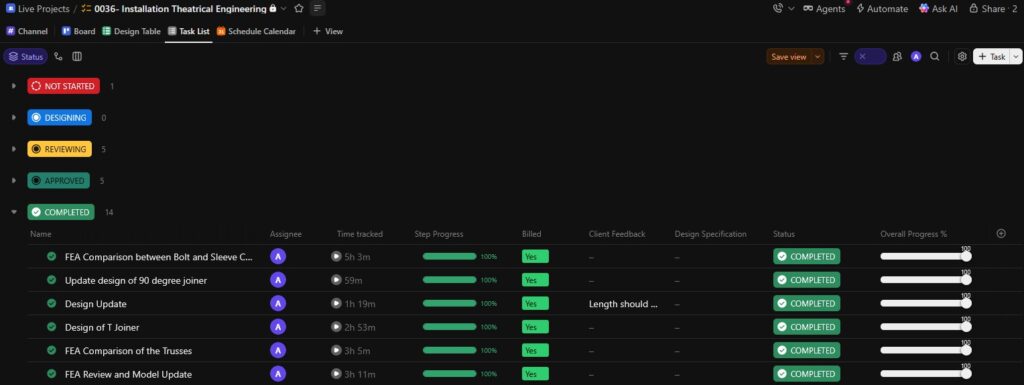
Throughout the development of the modular box truss system, ESD provided the client with structured visibility of project progress through a live project management platform. This included:

  • Task breakdown by development stage,
  • Milestone tracking,
  • Time allocation transparency,
  • Revision history documentation

Providing real-time access to project status ensured that the client remained informed throughout concept development, connection optimisation, structural analysis, and documentation phases.

This collaborative workflow supported:

  • Clear expectations,
  • Controlled scope management,
  • Transparent engineering delivery,
  • Efficient decision-making.

By integrating structured project tracking alongside technical development, the engineering process remained both rigorous and professionally managed from concept through to verification.

Project management dashboard showing structured task tracking and milestone visibility during theatre lighting truss engineering development.

Client Testimonial

Alireza has been fantastic to work with from start to finish. He has been efficient, well structured and extremely capable. I would recommend EsoliDesign to anyone looking for an experienced structural engineer.

Jonathon Agosta
Director
top
SEND US A MAIL

Let’s Discuss Your Project

    Launch Your Project

    At ESoliDesign, we’re here to bring your vision to life. Whether you have a question, need a consultation, or want to discuss your next project, our team is ready to help.

    Fill out our contact form, and we’ll get back to you promptly. Let’s create something exceptional together!

    Contact:

    Melbourne, Australia